
The Blueprint for Better Work:
A Beginner’s Guide to Modern
Project Management
If you have ever felt like your team is working incredibly hard but somehow missing deadlines, or that critical information is constantly getting lost in email chains, you have experienced a project management failure.
At its core, project management is not just about tracking tasks; it is the science of getting things done efficiently. It is the framework that turns a messy, complex idea into a finished product, on time and within budget.
For anyone new to this space, the terminology can feel overwhelming agile, sprints, milestones, dependencies. But strip away the jargon, and successful project management relies on mastering three fundamental phases. Here is what you need to know to take control of your work, and why the right infrastructure makes all the difference.
1. The Planning Phase: Building the Foundation
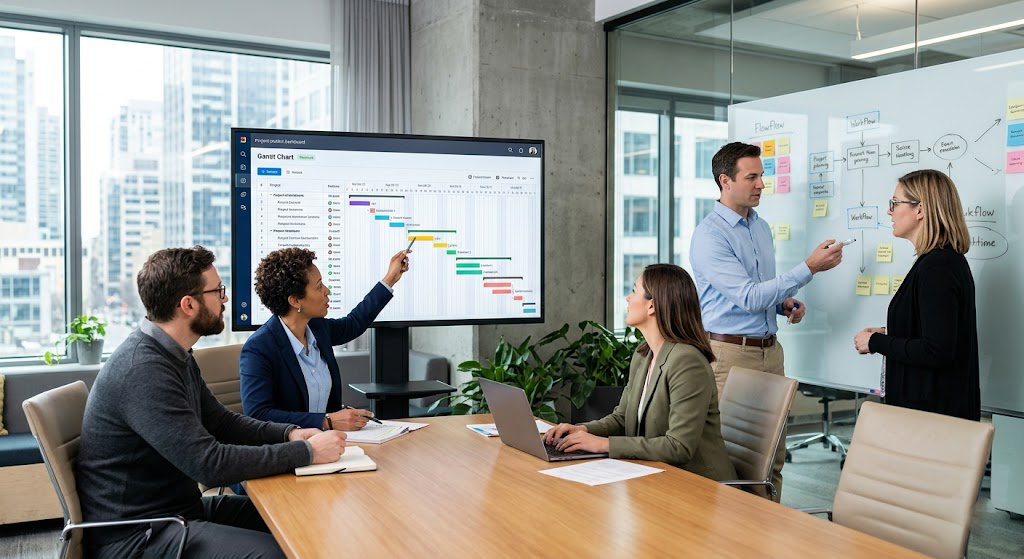
A project is doomed before it begins if the scope is not clearly defined. Planning is where you determine exactly what needs to be achieved, who is going to do it, and how long it will take.
What you need to learn:
⮞ Scope Definition: Clearly outlining what is included in the project (and just as importantly, what is not included to avoid “scope creep”).
⮞ Resource Allocation: Assigning the right people to the right tasks based on their capacity, ensuring top performers aren’t pushed to burnout.
⮞ Dependencies: Understanding which tasks rely on others. (You cannot put the roof on a house until the walls are up.)
2. The Collaboration Phase: Creating a Central Hub
Once a project begins, the biggest threat to success is fragmented communication. If the design team is using a chat app, the finance team is using spreadsheets, and the client is communicating via email, data silos form.
What you need to learn:
⮞ The Single Source of Truth: Every stakeholder must have access to one centralized location where all files, updates, and feedback live.
⮞ Version Control: Ensuring everyone is working on the most up-to-date document to prevent costly rework.
3. The Visibility Phase: Tracking and Adapting
No project goes exactly as planned. The mark of good project management is not avoiding roadblocks, but spotting them early enough to pivot.
What you need to learn:
⮞ Real-Time Reporting: Moving away from weekly manual status updates and relying on live dashboards that show budget burn rates and timeline progress instantly.
⮞ Risk Mitigation: Using current data to forecast potential delays before they happen.
The Breaking Point: Why Knowing the Theory Isn't Enough
Many businesses understand these three phases perfectly. They know they need better planning, collaboration, and visibility. So why do projects still fail?
Because they try to execute modern strategies using outdated tools. They attempt to manage enterprise-level work on static spreadsheets and manual email chains.
This is the exact gap where business operations break down and it is exactly what we solve.
What We Do: Architecting Your Project Infrastructure
As an IT services and implementation partner, we do not just tell you how to manage a project; we build the engine that makes it possible.
We recognize that buying a software license doesn’t fix a broken process. If you bring a powerful collaborative tool into a disorganized company, you just get disorganized faster. That is why our approach focuses on transformation:
⮞ Process Consulting: We audit how your teams currently work, identifying the bottlenecks, the manual busywork, and the communication gaps.
⮞ System Architecture: We design a customized technology stack—leveraging the industry’s most powerful project management and collaboration platforms tailored specifically to your operational needs.
⮞ Implementation & Training: We handle the technical heavy lifting, integrate the new systems with your existing tech, and train your team to ensure maximum adoption.
Project management is the heartbeat of a successful business. But turning the theory of good management into a daily reality requires the right digital infrastructure. You provide the vision for your business; we build the workspace that brings it to life.